


A high-level discussion panel titled “Nuclear Non-Proliferation at Risk: Prevailing Trends and Discourses” convened on November 16 at the Institute for Political and International Studies (IPIS), where international experts warned that deliberate attacks on peaceful nuclear facilities represent a severe breach of international norms that directly endangers the global non-proliferation regime.
Panelists included Kazem Gharibabadi, Iran’s Deputy Foreign Minister for International Legal Affairs; Mick Wallace, former Member of the European Parliament from Ireland; Stefan Harabin, former Minister of Justice of Slovakia; Giulio Chinappi, Senior Research Fellow at Italy’s Centro Studi Eurasia Mediterraneo; and Anton Khlopkov, Director of Russia’s CENESS.
Moderated by Hossein Sadat Meidani of Iran’s School of International Relations, the panel underscored that such assaults erode trust, undermine transparency, and jeopardize both human and environmental security.
The panel's critique was anchored by the remarks of Kazem Gharibabadi, Iran's Deputy for International and Legal Affairs, who highlighted the West's "discriminatory approach." He contrasted the strong international condemnation of attacks on nuclear facilities in Ukraine with the silence following the aggression against Iran. "Everybody kept quiet, they kept silence," he stated, arguing that Western powers even blocked a resolution on the matter at the IAEA General Conference, proving that "politics works here, not the legal foundations."
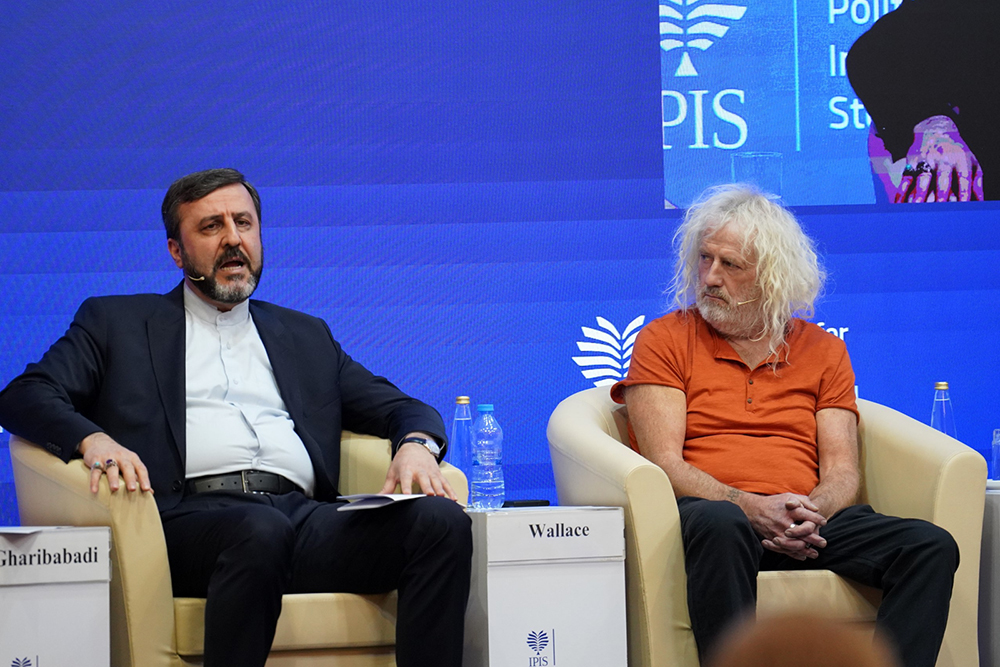
Mick Wallace described the European Union as "dripping with hypocrisy." He stated it was "shocking that the Europeans, not one EU member state, condemned the Israeli and American attacks on Iran." Contrasting the EU's past criticisms of Iran with its silence on the killing of tens of thousands in Palestine, he argued this reveals a "colonial mindset" of "the civilized against the barbarians." Wallace concluded that the EU no longer has an independent foreign policy and has become a "token puppet of the US Empire."
The discussion was framed around key questions, including the legal implications of striking safeguarded facilities, the consequences for global peace and environmental safety, measures to reinforce the authority of the NPT, and long-term strategies to bolster the resilience of the non-proliferation system against politically motivated violations.
Giulio Chinappi stated, "Europe is not a power at all in the 21st century." He argued that Europe has lost its agency, possessing no independent foreign or economic policy and simply following dictates from Washington. He asserted that non-proliferation has become a "weapon of the United States to keep its hegemony" and that the only solution can come from a new world order created by emerging powers. "Associations like the BRICS can create a new world order based on real, democratic international law where all countries matter the same," he said.
The panel stressed that if such actions remain unchecked, they could weaken confidence in multilateral mechanisms and embolden further unlawful behavior. Strengthening accountability, reaffirming states’ peaceful nuclear rights, and condemning attacks on civilian nuclear infrastructure were identified as essential steps for preserving the credibility of the non-proliferation regime.


